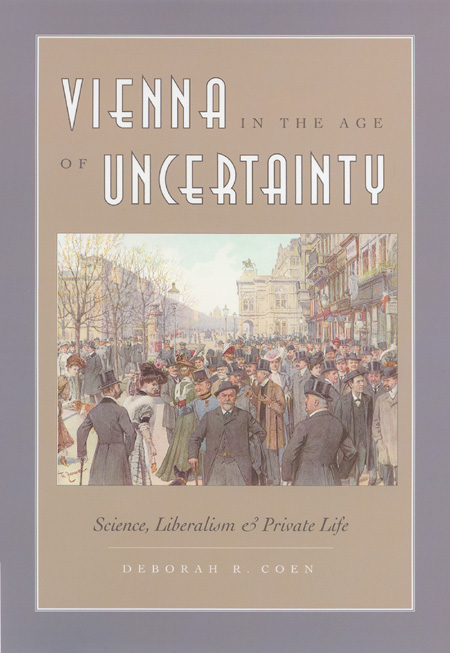
Vienna in the Age of Uncertainty
Science, Liberalism, and Private Life
Vienna in the Age of Uncertainty
Science, Liberalism, and Private Life
Publication supported by the Susan Elizabeth Abrams Fund in History of Science
Vienna in the Age of Uncertainty traces the vital and varied roles of science through the story of three generations of the eminent Exner family, whose members included Nobel Prize–winning biologist Karl Frisch, the teachers of Freud and of physicist Erwin Schrödinger, artists of the Vienna Secession, and a leader of Vienna’s women’s movement. Training her critical eye on the Exners through the rise and fall of Austrian liberalism and into the rise of the Third Reich, Deborah R. Coen demonstrates the interdependence of the family’s scientific and domestic lives, exploring the ways in which public notions of rationality, objectivity, and autonomy were formed in the private sphere. Vienna in the Age of Uncertainty presents the story of the Exners as a microcosm of the larger achievements and tragedies of Austrian political and scientific life in the late nineteenth and early twentieth centuries.
392 pages | 22 halftones | 6 x 9 | © 2007
History: European History
Physical Sciences: History and Philosophy of Physical Sciences
Reviews

Table of Contents
Introduction: A Scientific Dynasty
1 The Mind Set Free: Preparing a Liberal Society in the 1840s
2 In the Stream of the World: Coming of Age in the 1860s
3 Memory Images: Models of Reason in the Liberal Age
4 The Pigtail of the Nineteenth Century: Determinism in the 1880s
5 Afterlife: Inheritance at the Fin de Siècle
6 The Education of the Normal Eye: Visual Learning circa 1900
7 Citizens of the Most Probable State: The Politics of Learning, 1908
8 Into the Open: Measuring Uncertainty, 1900–1914
9 The Irreplaceable Eye: Visual Statistics, 1914–1926
Conclusion: A Family’s Legacy
Appendix: The Exner-Frisch Family Tree
Bibliography
Index
Awards
Center for Austrian Studies/U. of Minnesota, Austrian Cultural Forum, NY: Austrian Cultural Forum Book Prize
Won
Association for Slavic, East European, & Eurasian Studies: Barbara Jelavich Book Prize
Won
University of Chicago Press: Susan E. Abrams Prize in History of Science
Won