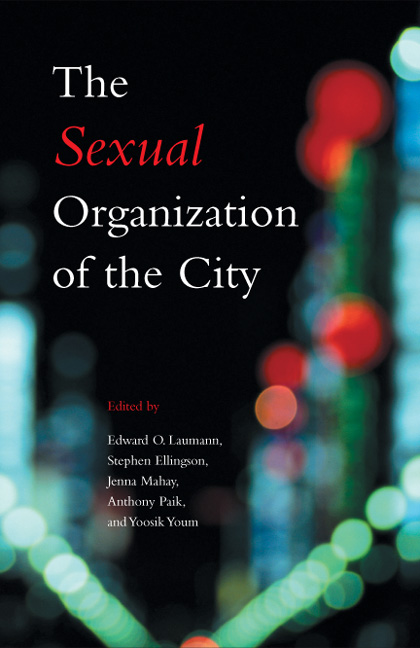
The Sexual Organization of the City
9780226468976
9780226470337
The Sexual Organization of the City
We think of the city as a place where anything goes. Take the sensational fantasies and lurid antics of single women on Sex in the City or young men on Queer as Folk, and you might imagine the city as some kind of sexual playground—a place where you can have any kind of sex you want, with whomever you like, anytime or anywhere you choose.
But in The Sexual Organization of the City, Edward Laumann and company argue that this idea is a myth. Drawing on extensive surveys and interviews with Chicago adults, they show that the city is—to the contrary—a place where sexual choices and options are constrained. From Wicker Park and Boys Town to the South Side and Pilsen, they observe that sexual behavior and partnering are significantly limited by such factors as which neighborhood you live in, your ethnicity, what your sexual preference might be, or the circle of friends to which you belong. In other words, the social and institutional networks that city dwellers occupy potentially limit their sexual options by making different types of sexual activities, relationships, or meeting places less accessible.
To explain this idea of sex in the city, the editors of this work develop a theory of sexual marketplaces—the places where people look for sexual partners. They then use this theory to consider a variety of questions about sexuality: Why do sexual partnerships rarely cross racial and ethnic lines, even in neighborhoods where relatively few same-ethnicity partners are available? Why do gay men and lesbians have few public meeting spots in some neighborhoods, but a wide variety in others? Why are African Americans less likely to marry than whites? Does having a lot of friends make you less likely to get a sexually transmitted disease? And why do public health campaigns promoting safe sex seem to change the behaviors of some, but not others?
Considering vital questions such as these, and shedding new light on the city of Chicago, this work will profoundly recast our ideas about human sexual behavior.
But in The Sexual Organization of the City, Edward Laumann and company argue that this idea is a myth. Drawing on extensive surveys and interviews with Chicago adults, they show that the city is—to the contrary—a place where sexual choices and options are constrained. From Wicker Park and Boys Town to the South Side and Pilsen, they observe that sexual behavior and partnering are significantly limited by such factors as which neighborhood you live in, your ethnicity, what your sexual preference might be, or the circle of friends to which you belong. In other words, the social and institutional networks that city dwellers occupy potentially limit their sexual options by making different types of sexual activities, relationships, or meeting places less accessible.
To explain this idea of sex in the city, the editors of this work develop a theory of sexual marketplaces—the places where people look for sexual partners. They then use this theory to consider a variety of questions about sexuality: Why do sexual partnerships rarely cross racial and ethnic lines, even in neighborhoods where relatively few same-ethnicity partners are available? Why do gay men and lesbians have few public meeting spots in some neighborhoods, but a wide variety in others? Why are African Americans less likely to marry than whites? Does having a lot of friends make you less likely to get a sexually transmitted disease? And why do public health campaigns promoting safe sex seem to change the behaviors of some, but not others?
Considering vital questions such as these, and shedding new light on the city of Chicago, this work will profoundly recast our ideas about human sexual behavior.
Read an excerpt.
435 pages | 1 map, 21 figures, 39 tables | 6 x 9 | © 2004
Sociology: Demography and Human Ecology, Sociology--Marriage and Family, Urban and Rural Sociology
Reviews

Table of Contents
List of Illustrations and Tables
Preface
Part One Introduction
1 ) The Theory of Sex Markets
2 ) The Chicago Health and Social Life Survey Design
Part Two The Structure of Urban Sexual Markets
3 ) Neighborhoods as Sex Markets
4 ) Race and the Construction of Same-Sex Sex Markets in Four Chicago Neighborhoods
Part Three Sexual and Social Consequences of Sexual Marketplaces
5 ) Meeting and Mating over the Life Course
6 ) The Sex Market and Its Implications for Family Formation
7 ) Commitment, Jealousy, and the Quality of Life
8 ) Violence and Sexuality: Examining Intimate-Partner Violence and Forced Sexual Activity
9 ) Social Networks and Sexually Transmitted Diseases
Part Four Institutional Responses and Silences
10 ) Constructing Causal Stories and Moral Boundaries:
Institutional Approaches to Sexual Problems
11 ) Religion and the Politics of Sexuality
12 ) The Cultural Economy of Urban Sexuality
References
Contributors
Author Index
Subject Index
Preface
Part One Introduction
1 ) The Theory of Sex Markets
2 ) The Chicago Health and Social Life Survey Design
Part Two The Structure of Urban Sexual Markets
3 ) Neighborhoods as Sex Markets
4 ) Race and the Construction of Same-Sex Sex Markets in Four Chicago Neighborhoods
Part Three Sexual and Social Consequences of Sexual Marketplaces
5 ) Meeting and Mating over the Life Course
6 ) The Sex Market and Its Implications for Family Formation
7 ) Commitment, Jealousy, and the Quality of Life
8 ) Violence and Sexuality: Examining Intimate-Partner Violence and Forced Sexual Activity
9 ) Social Networks and Sexually Transmitted Diseases
Part Four Institutional Responses and Silences
10 ) Constructing Causal Stories and Moral Boundaries:
Institutional Approaches to Sexual Problems
11 ) Religion and the Politics of Sexuality
12 ) The Cultural Economy of Urban Sexuality
References
Contributors
Author Index
Subject Index