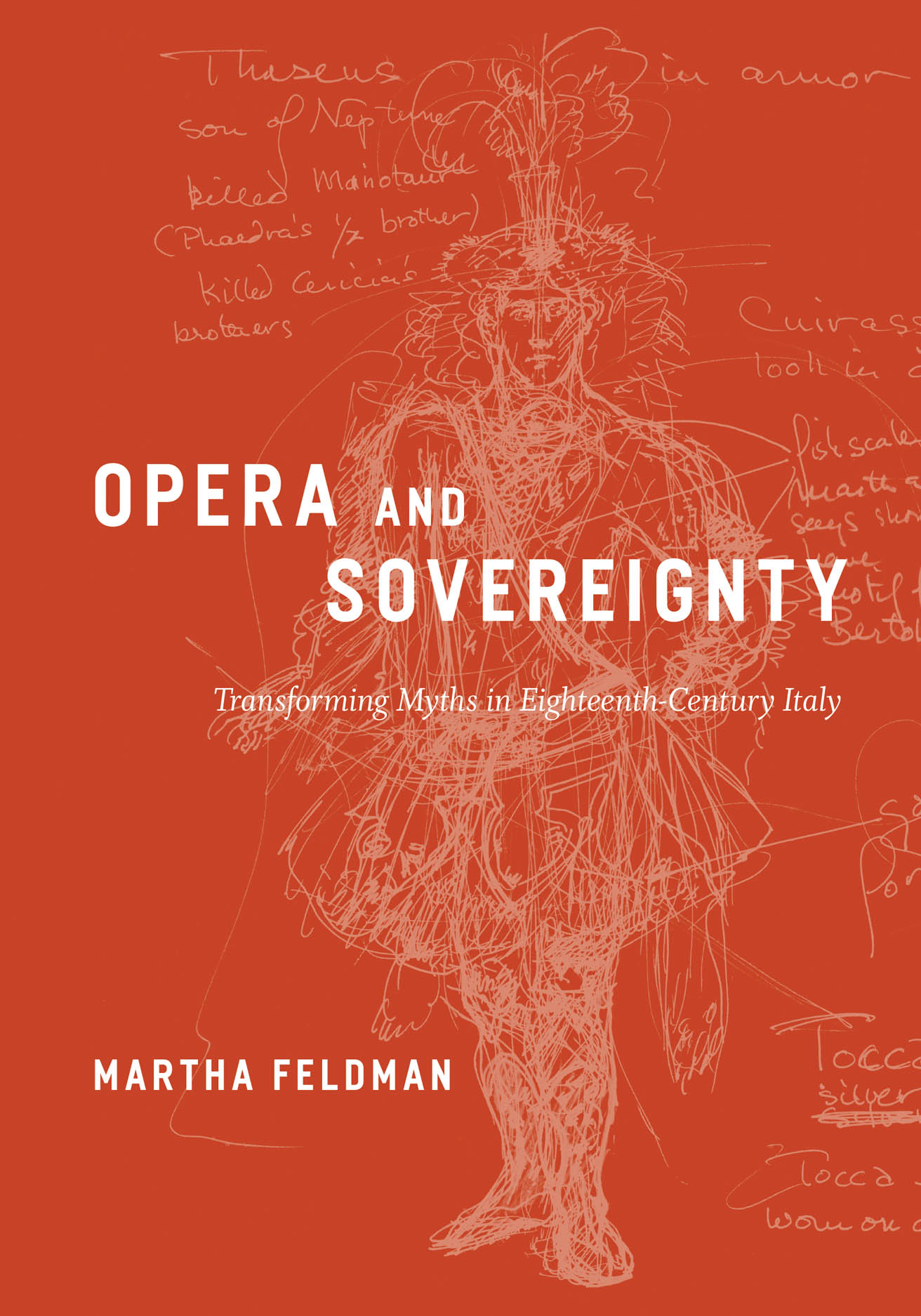
Opera and Sovereignty
Transforming Myths in Eighteenth-Century Italy
9780226241135
9780226044545
Opera and Sovereignty
Transforming Myths in Eighteenth-Century Italy
Performed throughout Europe during the 1700s, Italian heroic opera, or opera seria, was the century’s most significant musical art form, profoundly engaging such figures as Handel, Haydn, and Mozart. Opera and Sovereignty is the first book to address this genre as cultural history, arguing that eighteenth-century opera seria must be understood in light of the period’s social and political upheavals.
Taking an anthropological approach to European music that’s as bold as it is unusual, Martha Feldman traces Italian opera’s shift from a mythical assertion of sovereignty, with its festive forms and rituals, to a dramatic vehicle that increasingly questioned absolute ideals. She situates these transformations against the backdrop of eighteenth-century Italian culture to show how opera seria both reflected and affected the struggles of rulers to maintain sovereignty in the face of a growing public sphere. In so doing, Feldman explains why the form had such great international success and how audience experiences of the period differed from ours today. Ambitiously interdisciplinary, Opera and Sovereignty will appeal not only to scholars of music and anthropology, but also to those interested in theater, dance, and the history of the Enlightenment.
Taking an anthropological approach to European music that’s as bold as it is unusual, Martha Feldman traces Italian opera’s shift from a mythical assertion of sovereignty, with its festive forms and rituals, to a dramatic vehicle that increasingly questioned absolute ideals. She situates these transformations against the backdrop of eighteenth-century Italian culture to show how opera seria both reflected and affected the struggles of rulers to maintain sovereignty in the face of a growing public sphere. In so doing, Feldman explains why the form had such great international success and how audience experiences of the period differed from ours today. Ambitiously interdisciplinary, Opera and Sovereignty will appeal not only to scholars of music and anthropology, but also to those interested in theater, dance, and the history of the Enlightenment.
592 pages | 4 color plates, 46 halftones, 26 musical examples, 10 tables | 7 x 10 | © 2007
History: European History
Music: General Music
Sociology: Sociology of Arts--Leisure, Sports
Reviews

Table of Contents
Contents
List of Illustrations
Acknowledgments
Abbreviations
Editorial Principles
1 EVENINGS AT THE OPERA
Opera Seria, Sovereignty, Performance
Ritual and Event
Magic and Myth
Public Opinion
Evolutions
Crisis and Involution
2 ARIAS: FORM, FEELING, EXCHANGE
Ritornello Form as Rhetorical Exchange
The Singer as Magus
Rubbing into Magic
Frame
3 PROGRAMMING NATURE, PARMA, 1759: FIRST CASE STUDY
Enter Nature
Remaking Viewers
"Cruel Phaedra!": Ippolito ed Aricia
Pastoral Redemption, or The Old Order
Restored
Appendix: Decree on Audience Behavior, Parma, October 4, 1749
4 FESTIVITY AND TIME
Time and the Calendar
Festive Realms / Festive Spaces
Unbridling the Holy City
Laughter, Ridicule, Critique
Nature Revisited
Appendix: Edict of Abuses in the Theater, Rome, January 4, 1749
5 ABANDONMENTS IN A THEATER STATE, NAPLES 1764: SECOND CASE STUDY
Compounds of Royalty
The Sack of the Beggars and the Gift of the King
Didone abbandonata: Agonism and Exchange
Apocalyptic Endings
6 MYTHS OF SOVEREIGNTY
Of Myth and the Mythographer
Themistocles, Hero
History as Myth
Four Sovereigns and Two Heros
The Exemplary Prince and the Loyal Son: Artaxerxes and Arbaces
The Conquering Lover-King: Alexander the Great
A Hapeless Emperor: Hadrian
Proud Hero and Imperial Autocrat: Aetius and Valentian III
The King Cometh
Bataille’s Sovereigns: A Postscript on Identification
7 BOURGEOIS THEATRICS, PERUGIA, 1781: THIRD CASE STUDY
A Theater for the Middle Class
What Class is our Genre? Reworking Artaserse
Whether Purses or Persons
Toward the Ideology of a Bourgeoisie
Appendix: Annibale Mariotti’s Speech to the Accademia del Teatro Civico del Verzaro, December 31, 1781
8 MORALS AND MALCONTENTS
Dedications to Ladies
Conversations and "Femiuomini"
Regarding the Senses: Continuity, Accordance, Truth
The Family of Opera
9 DEATH OF THE SOVEREIGN, VENICE, 1797: FOURTH CASE STUDY
The Death of Time
Opera in a Democratic Ascension
16 pratile / June 4
La morte di Mitridate
Summer Season: Caesar, Brutus, and Joan of Ark
Moralizing the Spectator
Epilogue
References
Index
List of Illustrations
Acknowledgments
Abbreviations
Editorial Principles
1 EVENINGS AT THE OPERA
Opera Seria, Sovereignty, Performance
Ritual and Event
Magic and Myth
Public Opinion
Evolutions
Crisis and Involution
2 ARIAS: FORM, FEELING, EXCHANGE
Ritornello Form as Rhetorical Exchange
The Singer as Magus
Rubbing into Magic
Frame
3 PROGRAMMING NATURE, PARMA, 1759: FIRST CASE STUDY
Enter Nature
Remaking Viewers
"Cruel Phaedra!": Ippolito ed Aricia
Pastoral Redemption, or The Old Order
Restored
Appendix: Decree on Audience Behavior, Parma, October 4, 1749
4 FESTIVITY AND TIME
Time and the Calendar
Festive Realms / Festive Spaces
Unbridling the Holy City
Laughter, Ridicule, Critique
Nature Revisited
Appendix: Edict of Abuses in the Theater, Rome, January 4, 1749
5 ABANDONMENTS IN A THEATER STATE, NAPLES 1764: SECOND CASE STUDY
Compounds of Royalty
The Sack of the Beggars and the Gift of the King
Didone abbandonata: Agonism and Exchange
Apocalyptic Endings
6 MYTHS OF SOVEREIGNTY
Of Myth and the Mythographer
Themistocles, Hero
History as Myth
Four Sovereigns and Two Heros
The Exemplary Prince and the Loyal Son: Artaxerxes and Arbaces
The Conquering Lover-King: Alexander the Great
A Hapeless Emperor: Hadrian
Proud Hero and Imperial Autocrat: Aetius and Valentian III
The King Cometh
Bataille’s Sovereigns: A Postscript on Identification
7 BOURGEOIS THEATRICS, PERUGIA, 1781: THIRD CASE STUDY
A Theater for the Middle Class
What Class is our Genre? Reworking Artaserse
Whether Purses or Persons
Toward the Ideology of a Bourgeoisie
Appendix: Annibale Mariotti’s Speech to the Accademia del Teatro Civico del Verzaro, December 31, 1781
8 MORALS AND MALCONTENTS
Dedications to Ladies
Conversations and "Femiuomini"
Regarding the Senses: Continuity, Accordance, Truth
The Family of Opera
9 DEATH OF THE SOVEREIGN, VENICE, 1797: FOURTH CASE STUDY
The Death of Time
Opera in a Democratic Ascension
16 pratile / June 4
La morte di Mitridate
Summer Season: Caesar, Brutus, and Joan of Ark
Moralizing the Spectator
Epilogue
References
Index