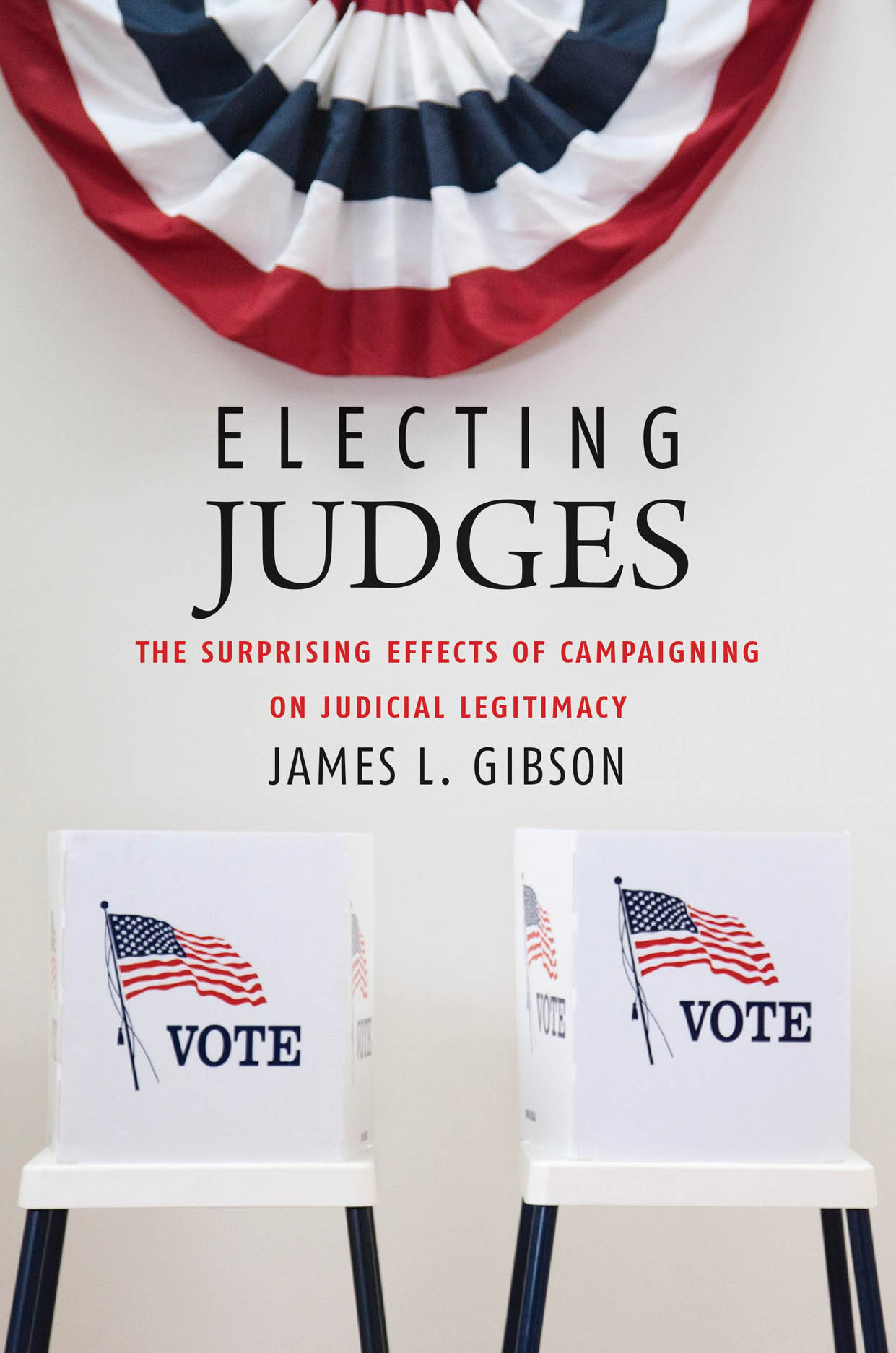
Electing Judges
The Surprising Effects of Campaigning on Judicial Legitimacy
9780226291086
9780226291109
Electing Judges
The Surprising Effects of Campaigning on Judicial Legitimacy
In Electing Judges, leading judicial politics scholar James L. Gibson responds tothe growing chorus of critics who fear that the politics of running for office undermine judicial independence and even the rule of law. While many people have opinions on the topic, few have supported them with actual empirical evidence. Gibson rectifies this situation, offering the most systematic and comprehensive study to date of the impact of campaigns on public perceptions of fairness, impartiality, and the legitimacy of elected state courts—and his findings are both counterintuitive and controversial.
Gibson finds that ordinary Americans do not conclude from campaign promises that judges are incapable of making impartial decisions. Instead, he shows, they understand the process of deciding cases to be an exercise in policy making, rather than of simply applying laws to individual cases—and consequently think it’s important for candidates to reveal where they stand on important issues. Negative advertising also turns out to have a limited effect on perceptions of judicial legitimacy, though the same cannot be said for widely hated campaign contributions.
Taking both the good and bad into consideration, Gibson argues persuasively that elections are ultimately beneficial in boosting the institutional legitimacy of courts, despite the slight negative effects of some campaign activities. Electing Judges will initiate a lively debate inside both the halls of justice and the academy.
240 pages | 1 halftone, 15 line drawings, 20 tables | 6 x 9 | © 2012
Chicago Studies in American Politics
Law and Legal Studies: Law and Society
Political Science: American Government and Politics, Judicial Politics
Reviews

Table of Contents
Preface and Acknowledgments
One The “New Style” Judicial Elections in the American States
Two Republican Party of Minnesota v. White and Perceptions of Judicial Impartiality
Three Can Campaign Activity Cross the Line?
Four Diffuse Support for a State Supreme Court: Judicial Legitimacy in Kentucky
Five Expectancy Theory and Judicial Legitimacy
Six Judges, Elections, and the American Mass Public: The Effects of Judicial Campaigns on the Legitimacy of Courts
Seven Judicial Campaigns, Elections for Judges, and Court Legitimacy:
Do Judicial Elections Really Stink?
Appendix A Legal Developments Post-White
Appendix B The Surveys
Appendix C Experimental Vignettes
Appendix D Question Wording
Appendix E The Distributions of Key Analytical Variables
Appendix F Interactive Analysis
Appendix G Measuring Support for Democratic Institutions and Processes
Appendix H Question Wording
Appendix I Adding Control Variables
Notes
References
Index