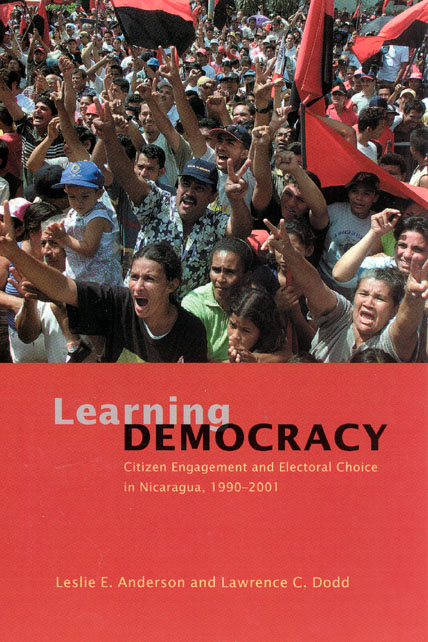
Learning Democracy
Citizen Engagement and Electoral Choice in Nicaragua, 1990-2001
9780226019727
9780226019710
9780226019741
Learning Democracy
Citizen Engagement and Electoral Choice in Nicaragua, 1990-2001
Historically, Nicaragua has been mired in poverty and political conflict, yet the country has become a model for the successful emergence of democracy in a developing nation. Learning Democracy tells the story of how Nicaragua overcame an authoritarian government and American interventionism by engaging in an electoral revolution that solidified its democratic self-governance.
By analyzing nationwide surveys conducted during the 1990, 1996, and 2001 Nicaraguan presidential elections, Leslie E. Anderson and Lawrence C. Dodd provide insight into one of the most unexpected and intriguing recent advancements in third world politics. They offer a balanced account of the voting patterns and forward-thinking decisions that led Nicaraguans to first support the reformist Sandinista revolutionaries only to replace them with a conservative democratic regime a few years later. Addressing issues largely unexamined in Latin American studies, Learning Democracy is a unique and probing look at how the country’s mass electorate moved beyond revolutionary struggle to establish a more stable democratic government by realizing the vital role of citizens in democratization processes.
By analyzing nationwide surveys conducted during the 1990, 1996, and 2001 Nicaraguan presidential elections, Leslie E. Anderson and Lawrence C. Dodd provide insight into one of the most unexpected and intriguing recent advancements in third world politics. They offer a balanced account of the voting patterns and forward-thinking decisions that led Nicaraguans to first support the reformist Sandinista revolutionaries only to replace them with a conservative democratic regime a few years later. Addressing issues largely unexamined in Latin American studies, Learning Democracy is a unique and probing look at how the country’s mass electorate moved beyond revolutionary struggle to establish a more stable democratic government by realizing the vital role of citizens in democratization processes.
336 pages | 17 line drawings, 20 tables | 6 x 9 | © 2005
History: Latin American History
Political Science: Comparative Politics, Political Behavior and Public Opinion
Reviews

Table of Contents
Preface
1. The Democratic Experiment in Nicaragua: An Introduction
1. The Democratic Experiment in Nicaragua: An Introduction
Part I. Pathways toward Democracy: The Case of Nicaragua
Chapter 2. Foundations of Nicaraguan Democracy: Space, Class, and Party
Chapter 3. Embracing Electoral Choice: Political Discourse and the 1990 Campaign
Chapter 2. Foundations of Nicaraguan Democracy: Space, Class, and Party
Chapter 3. Embracing Electoral Choice: Political Discourse and the 1990 Campaign
Part II. Choice amidst Crisis: Public Opinion in 1990
Chapter 4. An Empirical Theory of Electoral Choice
Chapter 5. Citizen Attitudes in 1990: Candidates, the Economy, and the Regime
Chapter 6. The Voters Are Not Fools: Modeling the 1990 Presidential Election
Chapter 4. An Empirical Theory of Electoral Choice
Chapter 5. Citizen Attitudes in 1990: Candidates, the Economy, and the Regime
Chapter 6. The Voters Are Not Fools: Modeling the 1990 Presidential Election
Part III. Affirming the 1990 Choice: The 1996 and 2001 Elections in Context
Chapter 7. The Post-1990 Context: Democratic Foundations and Public Choice
Chapter 8. Reaffirming Citizen Choice: The 1996 and 2001 Elections
Chapter 9. Learning Democracy In and From Nicaragua: Concluding Perspectives
Appendix
Bibliography
Chapter 7. The Post-1990 Context: Democratic Foundations and Public Choice
Chapter 8. Reaffirming Citizen Choice: The 1996 and 2001 Elections
Chapter 9. Learning Democracy In and From Nicaragua: Concluding Perspectives
Appendix
Bibliography